If you ask most parents in India,
“When does education really begin?”
You’ll hear answers like:
“From Class 1.”
“When they start writing.”
“When exams begin.”
But here’s the truth—
Education begins the moment a child starts asking “Why?”
And that usually happens long before school uniforms and homework.
Welcome to the world of preschool education in India, where the real learning begins.
Table of Contents
- What is Preschool Education (And Why It’s Not Just ABCs)?
- The Big Shift in India: From Marks to Mindset
- Why Preschool Education in India is More Important Than Ever
- 85% of Brain Development Happens Early
- First Lessons in Life (Not Just School)
- It Decides Whether Your Child Loves or Fears Learning
- The Reality: Not All Preschools Are Created Equal
- What Actually Makes the Best Preschool in India?
- Learning Through Play
- Emotional Safety
- Curious Conversations
- Individual Attention
- The TSWY Perspective: Childhood is Not a Race
- Wonder
- Imagine
- Discover
- A Quick Example
- Beyond Academics: The Real Goal is Confidence
- Parents Are Changing—And So Are Expectations
- The Future of Early Childhood Education in India
- A Final Thought (That Might Stay With You)
- Conclusion
What is Preschool Education (And Why It’s Not Just ABCs)?
Preschool education, also called early childhood education in India, focuses on children aged 3–6 years.
But let’s clear one myth:
It’s NOT about making a 3-year-old write A, B, C perfectly.
It’s about:
- Asking “Why is the sky blue?”
- Turning a cardboard box into a spaceship
- Learning to say “sorry” and “thank you.”
- Figuring out that crayons are not just for walls (eventually )
This stage builds:
- Cognitive skills
- Social behaviour
- Emotional intelligence
- Communication abilities
In simple words:
Preschool is where personality begins to take shape.
The Big Shift in India: From Marks to Mindset
For years, Indian education was like this:
“Sit straight. Learn fast. Don’t ask too many questions.”
Thankfully, things are changing.
With the introduction of the National Education Policy 2020, preschool is now part of the Foundational Stage (ages 3–8).
That means:
- Play-based learning is encouraged.
- Pressure is reduced
- Curiosity is celebrated
So yes—
Your child building a tower and knocking it down is now considered “learning.”
Progress, right?
Why Preschool Education in India is More Important Than Ever
1. 85% of Brain Development Happens Early
Think of a child’s brain like wet clay.
Whatever you shape early—stays.
The right early learning environment:
- Builds memory
- Improves problem-solving
- Boosts creativity
Miss this stage, and later learning becomes harder.
2. First Lessons in Life (Not Just School)
Preschool teaches things no textbook can:
- Waiting for your turn
- Sharing toys (even when you don’t want to )
- Making friends
- Dealing with emotions
These are life skills, not just school skills.
3. It Decides Whether Your Child Loves or Fears Learning
Imagine two children:
Child A:
Forced to write the alphabet repeatedly
Child B:
Learns letters through stories and games
Who do you think enjoys learning more?
Exactly.
That’s the difference a good play-based preschool in India makes.
The Reality: Not All Preschools Are Created Equal
Here’s the uncomfortable truth.
The preschool market in India is booming—but not always in the right way.
You’ll find:
- Fancy classrooms but rigid teaching
- Early pressure to read/write
- Worksheets replacing play
Some preschools look impressive…
But don’t feel right for the child.
And children can sense that instantly.
What Actually Makes the Best Preschool in India?
Let’s simplify it.
A great preschool is not about:
Air-conditioned classrooms
Imported toys
Fancy branding
It’s about:
Learning Through Play
Because children don’t learn by sitting still.
Emotional Safety
A child should feel: “I belong here.”
Curious Conversations
Not “Don’t ask questions.”
But “Let’s find out together.”
Individual Attention
Because every child learns differently.
The TSWY Perspective: Childhood is Not a Race
At TSWY – The Shri Ram Wonder Years, our approach to preschool education in India is built on one simple belief:
“Childhood is a journey of discovery, not a race to finish first.”
Instead of rushing children into academics, TSWY creates meaningful learning experiences through:
Wonder
Encouraging endless “why” questions and nurturing natural curiosity.
Imagine
Turning stories into immersive experiences that spark creativity.
Discover
Helping children learn by doing, exploring, and experimenting rather than memorising.
A Quick Example
Traditional classroom:
“Today we will learn the letter ‘A’.”
TSWY-style classroom:
“Let’s go on an adventure—A is for Apple, but also for Airplane… where do you want to go today?”
The alphabet is the same, but the experience is completely different. That’s the difference a child-centred approach makes in preschool education in India. To explore more about TSWY’s philosophy and learning approach, follow The Shri Ram Wonder Years on LinkedIn: https://www.linkedin.com/company/theshriramwy/.
Beyond Academics: The Real Goal is Confidence
Let’s be honest.
In today’s world, success is no longer defined by marks alone.
It’s about:
Confidence
Communication
Creativity
Emotional strength
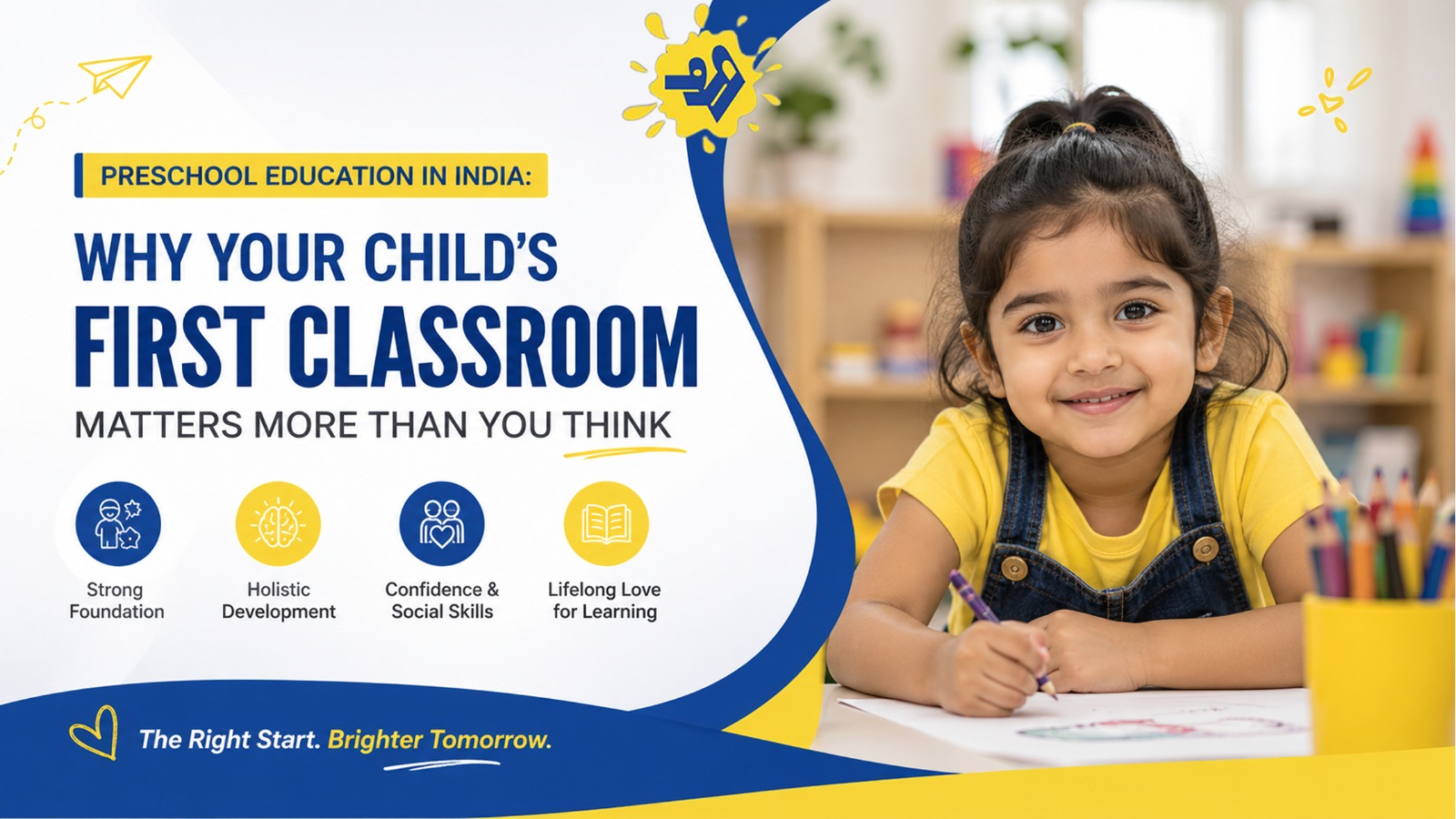
That’s why preschool education in India is increasingly focusing on holistic child development rather than academics alone.
At TSWY, children are encouraged to:
Express themselves
Speak without fear
Explore without judgment
Because confident children don’t just perform better—they thrive.
Parents Are Changing—And So Are Expectations
Today’s parents no longer ask only:
“Will my child learn?”
They also ask:
“Will my child enjoy learning?”
“Will the school nurture confidence, creativity, and emotional well-being?”
“Is this the right foundation for my child’s future?”
These changing expectations are reshaping preschool education in India, with parents looking beyond academics to schools that support holistic development, curiosity, and lifelong learning.
The Future of Early Childhood Education in India
The future of preschool education in India is entering a new phase where learning is designed around the needs of every child.
Play-based learning becomes the norm.
Teachers are trained in child psychology.
Preschools place equal importance on emotional development.
Parents become active partners in the learning journey.
And most importantly—
Childhood is respected, not rushed.
That’s the direction preschool education in India is moving toward—one that nurtures curiosity, confidence, and a lifelong love for learning.
The Future of Preschool Education in India Starts Here
In preschool education in India, success isn’t measured by how early a child starts writing—it’s measured by the foundation they build for lifelong learning.
If a child learns:
To read early, that’s good.
To think independently, that’s better.
To love learning, that’s everything.
Because education isn’t about how early a child starts writing.
It’s about how long they stay curious.
Conclusion
Preschool education in India is no longer just a stepping stone—it is the foundation of everything that follows.
The right preschool doesn’t just prepare a child for school.
It prepares them for life.
And in that journey, approaches like TSWY remind us of something important:
Children don’t need to be pushed to grow.
They need the right environment to bloom.